Looking closely at the State House
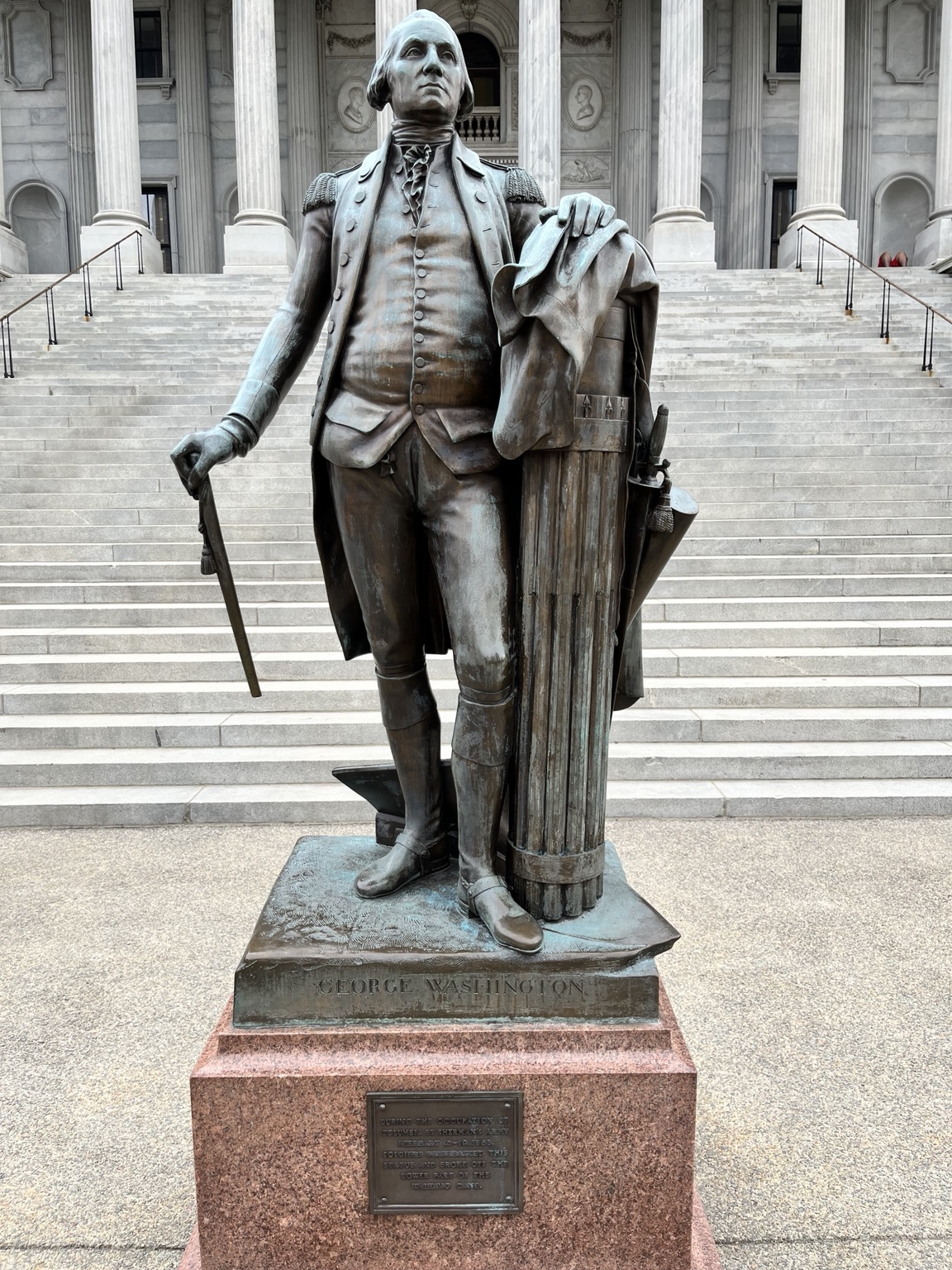
The Washington statue, its commemorative plaque and the State House grounds.
Photographs supplied by Vincent J. Esposito
Read the historical background
George Washington at the South Carolina State House
The bronze Washington statue connects South Carolina’s seat of government to the memory of the first president. The legislature identifies it as one of six bronze replicas made in 1857 from the earlier marble statue in Richmond, Virginia. Its classical presentation belongs to a long tradition of using public sculpture to express civic ideals.
The damaged walking cane deserves careful attention. The State House’s current account says it broke during relocation; the pedestal plaque gives a different account involving Sherman’s troops. The visible damage is real, but its cause should not be presented as settled on the strength of the commemorative inscription alone.
Historical sources: Read the source
Read the historical background
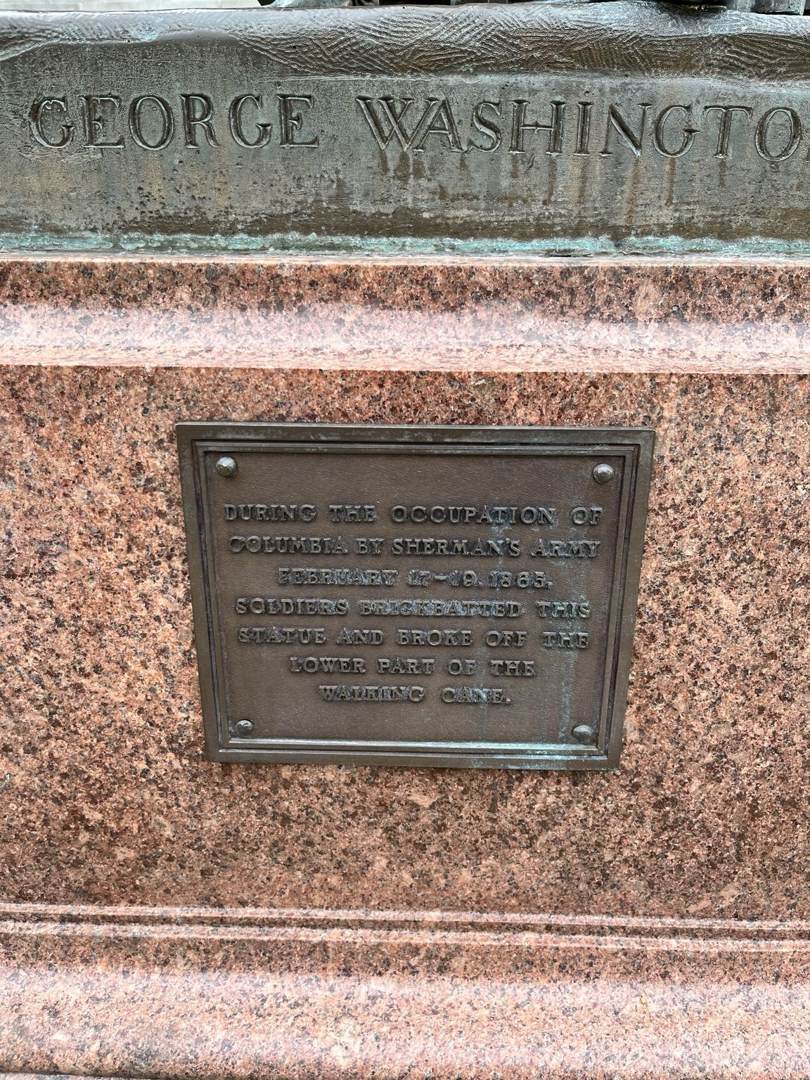
The Washington plaque: comparing an inscription with later interpretation
The pedestal plaque is part of the statue’s history of public remembrance. It attributes the damage to Washington’s cane to the Civil War, while the legislature’s current visitor information attributes the break to moving the statue. These conflicting explanations make the photograph an unusually useful lesson in evaluating historical evidence.
A plaque can establish what its sponsors wanted to commemorate, but it does not automatically prove every event it describes. Reading this inscription alongside the State House’s interpretation allows visitors to distinguish the physical object, the story told about it and the uncertainty that remains about a specific detail.
Historical sources: Read the source

Read the historical background
The State House: architecture, government and the grounds
The broad steps and formal facade frame the South Carolina State House as a place of public authority. The building and its grounds bring together the work of state government and a landscape of monuments through which successive generations have presented their versions of the past.
A visit is therefore more than an architectural stop. The placement of statues, memorial inscriptions and civic spaces invites questions about whose achievements are honored, who made those choices and which experiences were left out. Reading the grounds critically helps connect the building’s official function with the changing history of citizenship and public memory in South Carolina.
Historical sources: Read the source
Read the historical background
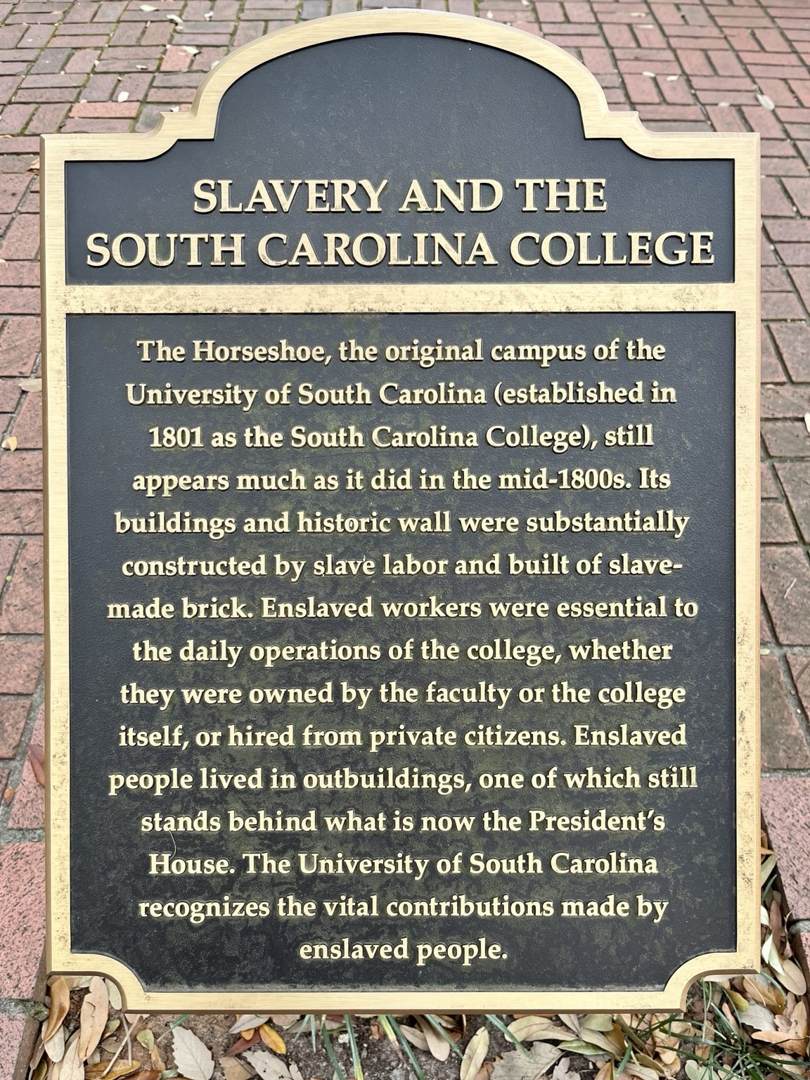
Slavery and South Carolina College
This marker concerns South Carolina College, established in 1801 and later the University of South Carolina. The university’s own interpretation acknowledges the contributions of enslaved people to the institution. The marker broadens the story of a historic campus beyond its prominent founders, graduates and architecture.
Its significance lies in recognizing the coerced labor behind an institution often presented through its educational achievements. Buildings and landscaped grounds did not operate by themselves: enslaved people helped sustain everyday campus life. Reading this marker alongside the city’s more celebratory monuments gives a fuller account of the society in which those institutions developed.
Historical sources: Read the source